

The printing that makes sounds
By Philip Burnett, Leverhulme Early Career Researcher, University of York
Tonic solfa is something that many have heard of, many have no idea what it is, while a few (very few these days) were taught it. Once upon a time in Britain it was ubiquitous. Now it has either been forgotten or thought of as quaint. Missionaries used it to teach music in many parts of the world where it remains a living means of musical literacy.
Over the course of my research into music on missions in Southern Africa, it has become clear that printing, tonic solfa, and missions have a close relationship.
I have often come across reports in which missionaries spoke of using a press to print hymns in local languages. There'd also be mention of using tonic solfa to teach musical literacy. While many of these ephemera and books were sent away to be printed on sophisticated presses in England, many, such as the one pictured below, were printed locally. It has made me interested in finding out more about the people who did the printing, who used what was printed, and how the presses, ink and other materials got to these often remote places.
The image below shows a hymnbook printed in 1925 at a place called Inhambane in what was known at the time as Portuguese East Africa, now Mozambique. It's a translation of 'Hark! the Herald Angels Sing', to be sung in a language called Xitsonga (known then as Shangaan). It is printed with the tune notated in tonic solfa and is one of many examples of a musical item printed by missionaries for use in the mission field.
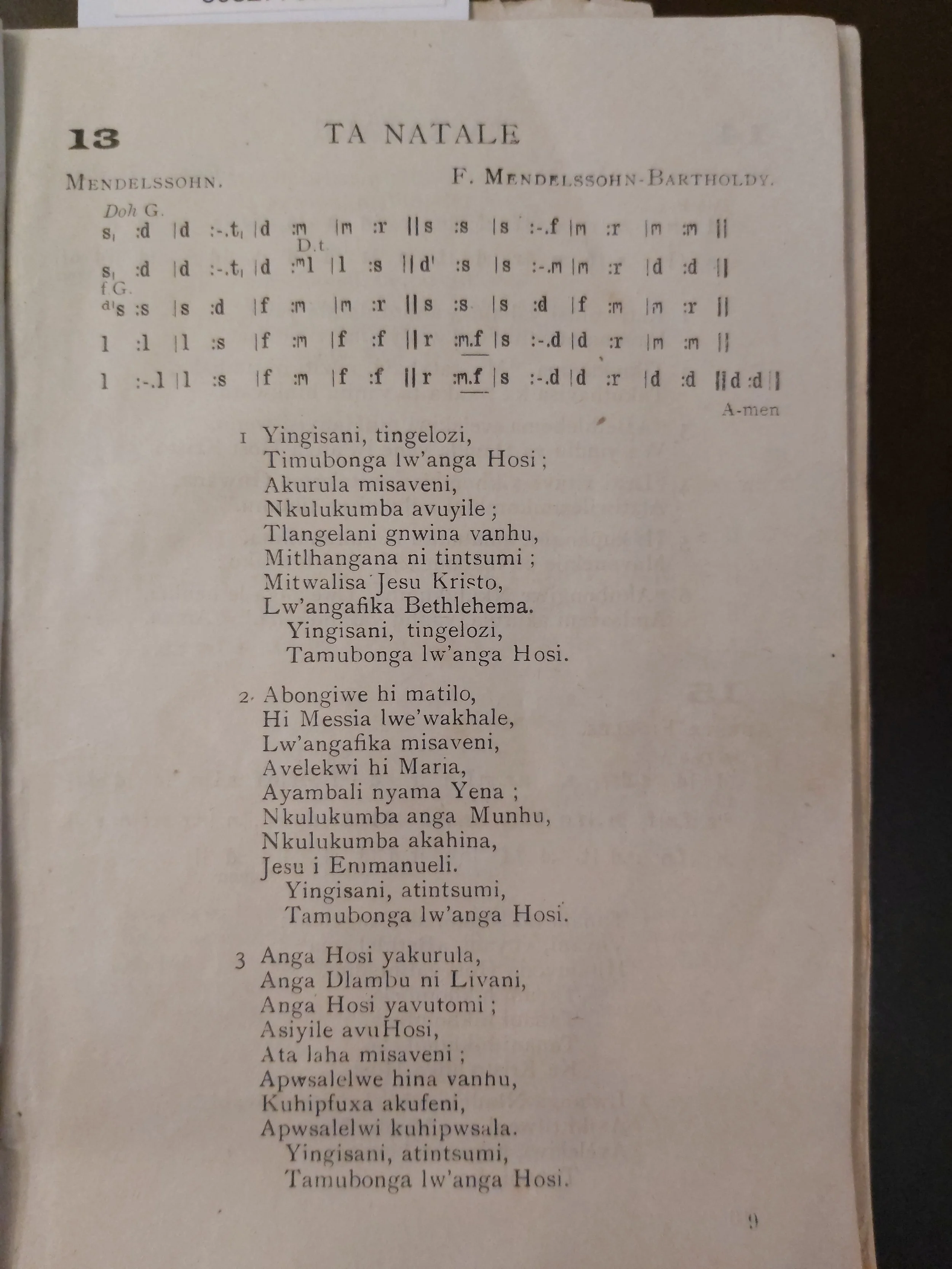
Page from Hymnos em Shangaana Chamboni, Inhambane: Imprinted at the Mission Press, 1925 (Bodleian Library USPG 1535, used with permission).
Missionaries belonging to an organisation called the Society for the Sacred Mission ran a station in Inhambane and they had a printing press. The SSM papers are kept in the Borthwick Institute for Archives, and contain an account of mission work by Robert Caroll who talks about printing in Inhambane where he worked in the early 20th century (Borthwick Institute for Archives, SSM Papers, Personal Papers, PP/4).
When I found out about Thin Ice Press, it seemed like a good opportunity to learn something about printing and how presses worked. I went to Thin Ice Press to meet with Helen Smith, Lizzy Holling, and Nick Gill in November 2024. I couldn't have been more thrilled when Nick told me that he had the means to create tonic solfa type.
We put together a workshop for the 2025 Festival of Ideas which we called 'Printing Sounds' which would explore tonic solfa and the missionary history found in the SSM Archives at the Borthwick. We designed a session that would include missionary history, some practical experience of setting type, and, of course, having a go at singing a hymn tune in tonic solfa.
The workshop took place during the afternoon of 13th June 2025. Although there wasn't enough time to set the entire hymn, everyone was able to print off a keepsake (see photo below). When it came to singing, we amazingly had at least one of every voice part so were able to sing the hymn in four-part harmony. Appropriately, the hymn tune selected was called 'York'. The sound of hearty singing in four parts drifted out from the Thin Ice workshop into Peasholme Green and the summer air.
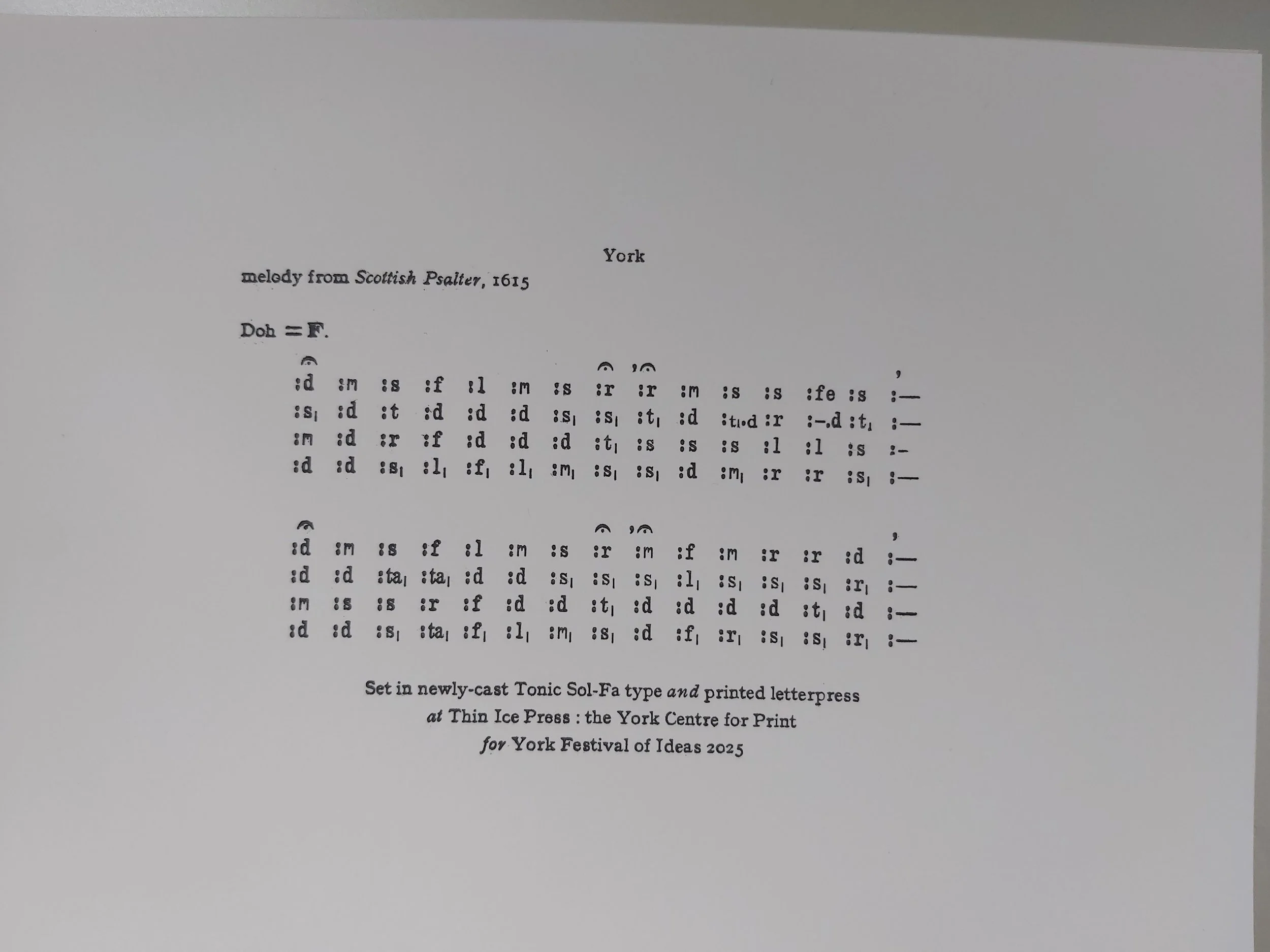
‘York’, melody from Scottish Psalter, 1615. Set in newly-cast Tonic Sol-Fa type.
My only disappointment from that afternoon was that I didn't get to have a go at printing, so it wasn't quite the experiential learning opportunity I had hoped for.
I made sure that my next term's teaching was about tonic solfa and hymns. The seminar session included a visit by the MA in Musicology group to Thin Ice's Derwent College print room. The group had a go at setting, printing, and then singing ‘York’. And this time I was able to have a go at squinting my eyes, thinking backwards, and seeing how to create a piece of tonic solfa printing. As far as we are aware, it was the first time that a group of music students printed music at Thin Ice Press.
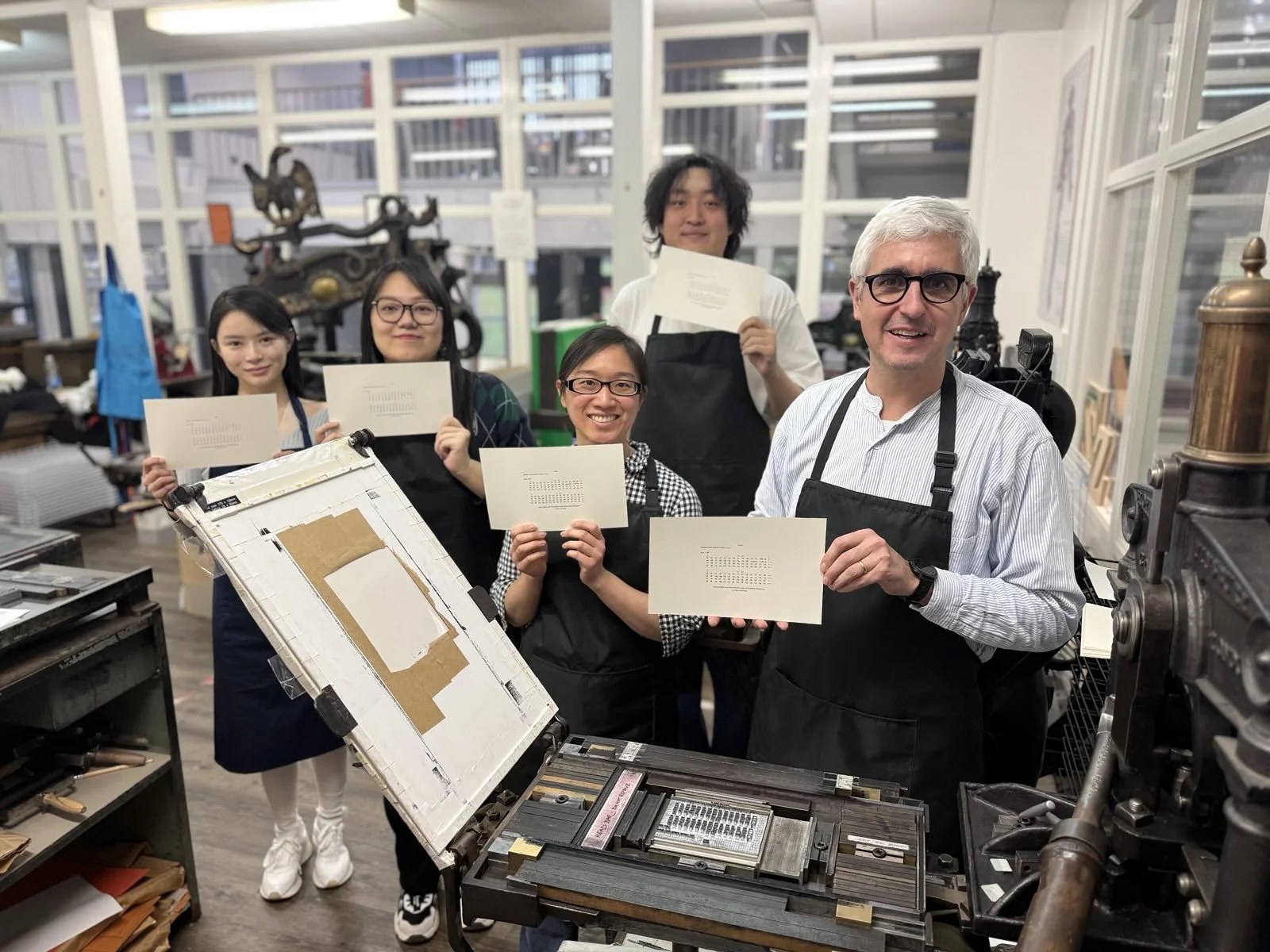
MA in Musicology group at Thin Ice Press on campus at the University of York.
There was a lot to take away from these two sessions. What struck me was how fascinated people were with tonic solfa and the thrill everyone had when seeing their own piece of printed music.
Special thanks to Helen, Lizzy, and Nick for their enthusiasm, advice, and making these sessions happen.